Whiplash recovery: managing desk work during neck rehabilitation
It usually starts the same way. A few days after a fender-bender or a sudden jolt at work, you settle into your chair and notice something is off.
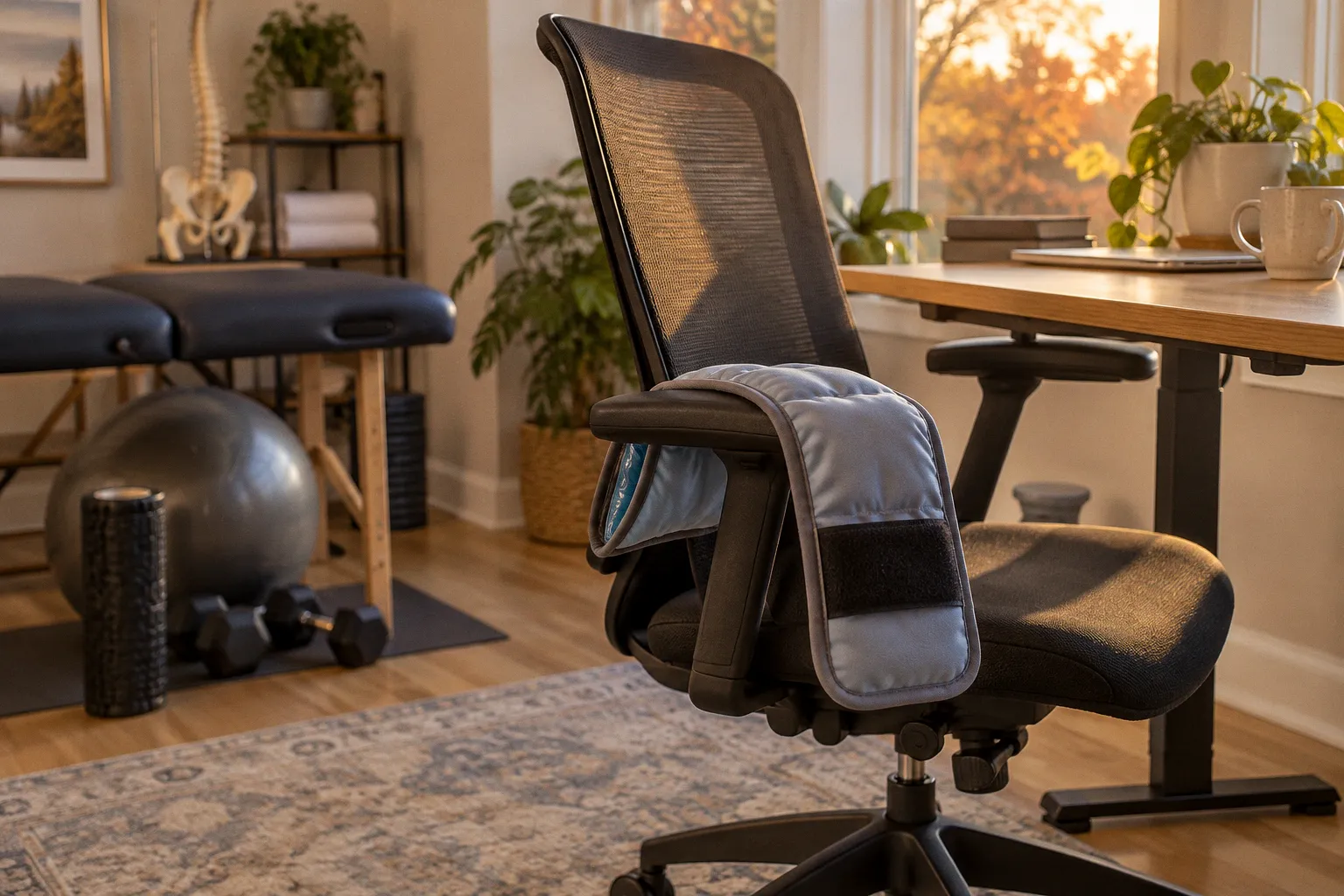
Your neck feels stiff when you turn to grab a printout, your shoulders begin to ache before lunch, and the email you've rewritten three times still doesn't read the way it should. You tell yourself the stiffness will fade by Friday. Friday arrives, and the screen still feels too bright, the chair still feels wrong, and you begin to suspect your desk job is quietly working against your own healing.
That quiet frustration is one of the most common things our office-based patients describe in the first consultation. You've done the responsible thing — you've shown up, you've kept your appointments, you've iced and stretched as we asked — but the laptop won't budge, the deadlines won't pause, and the temptation to push through the discomfort is enormous. We want you to know something important at the start: managing desk work during whiplash recovery has very little to do with willpower and everything to do with working alongside the biology of your neck.
The Hidden Load Your Desk Is Putting on a Healing Neck
Before we talk about timelines, let's get honest about what eight hours at a workstation actually does to a recovering cervical spine. When your head sits centered over your shoulders, the cervical vertebrae carry roughly ten to twelve pounds of load — about the weight of a bowling ball — and your neck is built for exactly that. The moment your chin drifts forward to look at a screen, that load grows quickly. In exaggerated forward-head posture, the effective weight pressing on the lower cervical joints can climb toward sixty pounds, and the small stabilizer muscles along the spine begin to fatigue long before the larger ones do.
During healthy tissue, your neck absorbs that postural load without complaint. In the first weeks after a whiplash event, though, the deep stabilizers are irritated, the soft tissues are inflamed, and the proprioceptors that normally cue you to adjust posture have been briefly scrambled by the rapid acceleration-deceleration of the injury. The result is a neck that is more vulnerable to load and less likely to tell you when you've crossed the line. A normal workday at a standard setup becomes, without realizing it, a prolonged strain on tissues still trying to knit themselves back together.
Your neck isn't fragile — it's healing. The goal of desk work during recovery isn't to stop using your spine; it's to stop overloading it.
This is why we lean toward active recovery rather than rigid rest or prolonged cervical immobilization. Rest within tolerance is healing. Rest past tolerance is deconditioning. Gentle load, applied correctly and graded upward as your symptoms allow, is what tells the tissues how to reorganize themselves in a way that holds up to daily life.
Where You Sit on the Recovery Curve
One of the most useful conversations we have in the early weeks is about time, because there is a real statistical shape to whiplash recovery, and knowing its contours keeps you from either expecting too much too soon or giving up just before the steepest gains.
For office workers with mild soft-tissue involvement, the typical resolution window lands between two and three weeks. Moderate cases — meaningful stiffness, headaches, and reduced range of motion that interferes with daily activity — usually take four to eight weeks, with about six as a common midpoint. The largest share of measurable improvement happens within the first three months after the injury. After that point, average gains become smaller and slower. That phrasing matters: smaller and slower is the honest description, not a guarantee that improvement stops at the three-month mark.
Here is what this typically looks like in practical terms for a desk-bound role:
| Recovery Phase | Typical Window | Desk Work Reality |
|---|---|---|
| Acute (first 1–7 days) | A few days to a week off is common | Brief time off is reasonable; full screen hours rarely tolerable |
| Early sub-acute (weeks 2–3) | Mild cases often returning | Modified hours, frequent microbreaks, capped screen time |
| Mid recovery (weeks 4–6) | Moderate cases resuming fuller duties | Tolerable for most; pacing still essential |
| Extended (weeks 6–12) | The "steep gains" window for moderate cases | Full workload usually sustainable, flare-ups possible |
| Plateau and refinement (3+ months) | Smaller weekly gains | Maintenance focus, residual stiffness often responsive to ongoing mobility work |
These are patterns from large cohorts of patients, not promises about your specific neck. Mild cases can drag on when aggravated by poor ergonomics, and moderate cases can resolve faster when the work setup actually supports healing. The point of the table is to give you a rough map, not a verdict. What your day looks like at week three will look very different from week seven, and adjusting your work plan as you move through these phases is part of the recovery itself.
Ergonomic Shifts That Actually Reduce Cervical Strain
The good news is that you don't need a thousand-dollar chair to take meaningful load off a healing neck. You need a small number of changes that work together, applied consistently, and adjusted as your tissue tolerance grows.
The first shift is monitor height. Your eyes should land in the upper third of the screen when you sit upright with your shoulders relaxed. Anything lower invites the chin to drift forward, and we already know where that leads. A laptop on a desk is the single most common setup we see working against recovery, because the screen and keyboard can't both be in their ideal position at the same time. Even a simple laptop stand paired with a separate keyboard and mouse changes the geometry meaningfully.
The second shift is the chair itself, but not in the way most people expect. Seat depth matters more than brand. You want two to three fingers of space between the edge of the seat and the back of your knee, with the lumbar curve of the chair actually meeting the lumbar curve of your spine. If your chair lacks that curve, a small rolled towel or a dedicated lumbar pillow fills the gap. When the low back is supported, the upper back and neck stop working so hard just to hold you upright.
The third shift is posture interval, not posture itself. Holding any single position — even a perfect one — for hours is its own form of static load. Recommended sit-to-stand ratios fall between 1:1 and 1:3, which in practical terms means standing for fifteen to thirty minutes for every thirty to sixty minutes of seated work. A sit-stand desk makes this easier, but a stack of sturdy boxes under a laptop works just as well if a new desk isn't in the budget during recovery.
The fourth shift is the microbreak. Every thirty minutes, take one to two minutes to look away from the screen, drop the shoulders, gently turn the head within a comfortable range, and reset the eyes on something across the room. These small breaks give the tissues a chance to redistribute fluid and recover circulation between bouts of load.
If you've noticed headaches creeping up behind your eyes by mid-afternoon, or a dull band of pressure across the base of your skull, your setup is almost certainly part of the reason, and these four shifts are where we'd begin.
Pacing Your Day with the Next-Day Rule
Of all the tools we teach, this is the one our patients tend to underestimate until they try it. It's simple, but it requires you to pay attention to your symptoms rather than push through them.
The next-day rule works like this. After any meaningful change to your work setup, your hours, or your rehab exercises, take note of how your neck feels the next morning and the morning after that. If symptoms are noticeably worse for twenty-four to forty-eight hours after a change, the load was beyond your current tissue tolerance, and something needs to scale back — the duration of the task, the range of a movement, the brightness of the screen, or the intensity of a particular exercise.
This rule is a feedback mechanism. It tells you exactly where the boundary sits between productive challenge and overreach, and that boundary shifts every week as your tissues adapt. We use it to titrate rehab the way a physician titrates medication: start low, observe the response, adjust by a measured step, then reassess.
Practically, here's how we apply it during a workday:
1. Set a small, specific exposure. For example, thirty minutes of focused screen work at your newly adjusted monitor height.
2. Record the symptom response at twenty-four and forty-eight hours. A short journal note, or even a single phrase on your phone, is enough.
3. If the response is the same or better, increase the exposure in a measured step — fifteen more minutes, a small range increase in an exercise, or one fewer microbreak.
4. If symptoms flare, pull the exposure back to the last comfortable level, hold there for a few days, and try again.
5. Reapply the cycle every week or two, as tolerance grows.
Used well, this rule turns recovery from a guessing game into a feedback loop. It also answers the question we hear most often: how do I know if I'm doing too much? Your neck will tell you, kindly and at a twenty-four-hour delay. Our job together is to help you read it accurately.
When the Neck Isn't the Only Thing Hurting
One last thing worth talking about, especially if your whiplash came from a more forceful collision. It's common for a neck injury to arrive alongside a mild traumatic brain injury, sometimes called a concussion, and the symptoms don't always show up right away. Difficulty concentrating, trouble multitasking, screen sensitivity, that sense that words are slightly harder to find than they used to be — these aren't signs that you're not trying hard enough. They are neurological symptoms, and they deserve real accommodation.
For office workers, cognitive symptoms often extend the return-to-full-work timeline more than the neck itself does. Screens can be genuinely fatiguing to an injured visual system, and high-demand tasks like data analysis or long meetings can trigger headaches that feel as if they're coming from the neck but actually originate in the brain. Pacing matters here too, just with different inputs — dimmer screens, shorter focus blocks, audio versions of long documents, and permission to step out of a meeting when the visual load becomes too high.
If this resonates, please bring it up in your next session. We can adjust your rehab plan to include vestibular and cognitive pacing alongside the cervical work, and that integrated approach tends to shorten the path back to full capacity considerably.
Closing Thoughts
Working through a neck injury is a sign of commitment, and resting through one is a sign of wisdom. Both have a place, and the art of recovery is learning which your tissues need on which day. Your cervical spine is built to handle remarkable loads — it carries your head, all day, every day, through thousands of micro-adjustments you never have to think about. Once the inflammation settles and the stabilizers remember their job, that capacity returns. The work we're doing together in these early weeks is simply clearing the path so it can.
Be patient with the pace. Trust the next-day rule. Adjust the desk before you adjust your pain tolerance. And please reach out before a flare-up turns into a setback — that's exactly what we're here for.