Lumbar spine decompression versus physical therapy for chronic back relief
Lumbar spine decompression can describe two different procedures: motorized traction delivered on a treatment table, or surgery to relieve pressure on spinal nerves. Physical therapy is a broader category of active care.
Comparing these options requires separating the two meanings of decompression and matching each to the patient’s symptoms and clinical findings.
For chronic low-back pain, the available evidence does not establish that nonsurgical, traction-based decompression works better than physical therapy. Guidelines generally favor individualized care built around activity, exercise, education, and appropriate assessment. Surgical decompression follows a different decision pathway, chiefly for selected people with sciatica whose pain or function has not improved with nonsurgical treatment and whose imaging findings match their symptoms.
First, define which kind of decompression is being considered
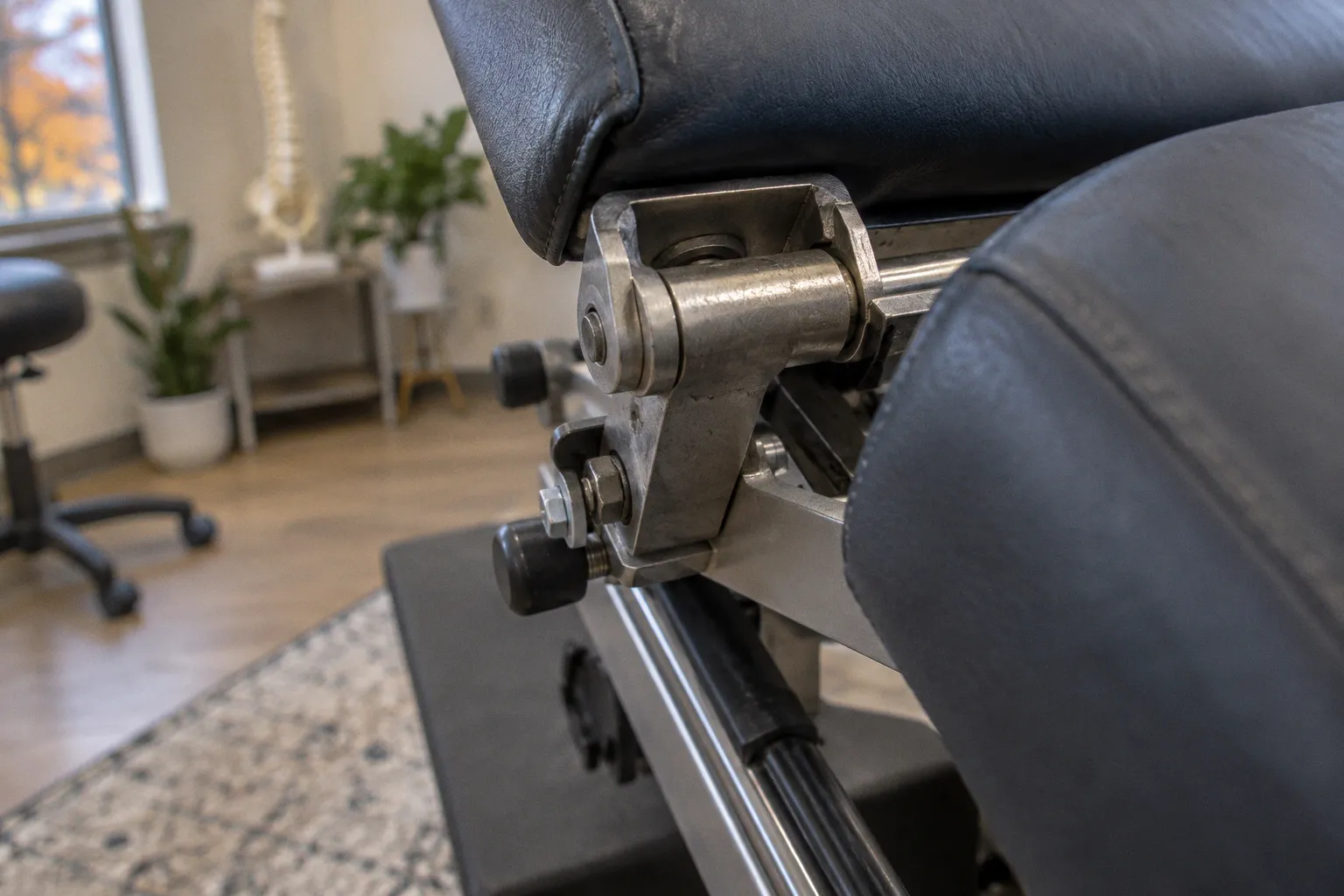
Motorized lumbar decompression uses a table or device to apply traction to the lower spine. The intended mechanical effect is to apply a controlled pulling force. Treatment is typically delivered in sessions, with settings and schedules determined by the provider and device protocol. The proposed mechanism does not, by itself, establish that treatment reduces pain or improves function.
Surgical spinal decompression is an operation. It aims to relieve pressure on neural structures by changing or removing tissue around the affected area. It may be considered when symptoms, examination findings, imaging, and response to nonsurgical care support that decision.
These interventions are not interchangeable. Evidence or guidance about surgical decompression cannot be used to validate a traction table. The National Institute for Health and Care Excellence (NICE), for example, recommends considering surgical decompression for sciatica when nonsurgical treatment has not improved pain or function and imaging findings are consistent with sciatic symptoms. That recommendation concerns surgery.
| Option | What it involves | Main clinical question |
|---|---|---|
| Motorized, nonsurgical decompression | Device-applied lumbar traction | Does this form of traction improve the person’s pain and function? |
| Physical therapy | Individualized assessment, exercise, education, and other selected interventions | Which active and supportive treatments best address the person’s impairments and goals? |
| Surgical decompression | An operation intended to relieve pressure on neural structures | Do symptoms, imaging, and response to nonsurgical care support surgical evaluation? |
The phrase “spinal decompression therapy” in clinic or device marketing usually refers to traction, but the label can be imprecise. A patient comparing treatment options should ask which intervention is being offered, what measurable outcome it targets, and how progress will be assessed.
What guidelines say about traction and active care
Guidelines do not treat traction as a universal solution for every back-pain presentation. Their recommendations depend on the population and clinical context.
The World Health Organization recommends that traction not be used as routine care for adults with chronic primary low-back pain. The recommendation is conditional and based on very-low-certainty evidence. Its evidence review included 10 trials with 921 participants. The review found no long-term outcome data, and the included trials did not report harms. That means the evidence leaves substantial uncertainty about both lasting benefit and safety reporting; it does not provide a basis for promising a durable result.
The 2021 guideline from the American Physical Therapy Association’s Academy of Orthopaedic Physical Therapy advises against mechanical traction for chronic low-back pain with leg pain. Its reasoning is that traction did not provide added benefit when combined with other interventions in the evidence considered by the guideline.
These recommendations address defined clinical groups. They should not be broadened into a claim that traction is rejected for every diagnosis or every individual. Equally, they do not support presenting traction as a standard first-line treatment for chronic low-back pain.
The APTA guideline emphasizes physical activity and exercise, patient education, selective imaging, and high-quality nonsurgical care before surgery. In practice, physical therapy may include graded movement, strength and endurance work, mobility exercises, and strategies to manage activities that aggravate symptoms. The specific program should reflect the patient’s presentation rather than a fixed menu.
A traction device applies force. Clinical benefit has to be demonstrated through changes in symptoms and function.
What comparative studies can—and cannot—show
A systematic review and meta-analysis that searched studies through March 31, 2021, found no significant difference in pain or disability between lumbar decompression and other mechanical traction modalities. The authors rated the relevant evidence very low to low quality.
That result needs careful interpretation. It compares forms of mechanical traction; it does not establish that a commercial decompression-table protocol is equivalent to a standardized physical-therapy program. It also does not prove that the treatments are equally effective. When evidence quality is low, a finding of no significant difference can reflect limitations in the studies, including uncertainty about whether a real difference exists.
The available research also does not provide a reliable general estimate of how much nonsurgical decompression improves chronic back pain compared with a defined physical-therapy course. It does not establish which patients, device settings, treatment schedules, or chronic-pain subgroups are most likely to benefit.
This is why claims such as “decompression opens the disc space and fixes the cause” go beyond what the summarized evidence can confirm. A proposed mechanical effect is not the same as demonstrated improvement in pain, walking, sleep, lifting, or daily activity. Nor does the evidence support a guaranteed success rate or promise of permanent relief.
For a person with a herniated disc, the comparison still depends on the clinical pattern. Back pain alone, radiating leg pain, sensory changes, and weakness are different findings. Imaging also needs to be interpreted alongside symptoms; a scan does not independently establish which treatment will help. The evidence here does not show that traction is superior to physical therapy for herniated-disc symptoms.
Active rehabilitation and device-based treatment
Physical therapy is not a single exercise routine. It is an approach that can be adjusted as symptoms and capacity change. A therapist may assess spinal and hip movement, strength, endurance, neurological signs, and how particular tasks affect symptoms. The plan can then target limitations that matter to the patient.
A traction-table protocol is more narrowly defined by the device and its settings. It may be offered as one part of care, but passive treatment does not automatically build the strength, movement tolerance, or task capacity needed for daily activity. If it is used, its role should be clear and its results should be tracked alongside an active plan where appropriate.
A useful comparison asks what each option is expected to change:
- Pain and leg symptoms: Record where symptoms occur and whether their intensity or distribution changes. Persistent or increasing neurological symptoms require clinical reassessment.
- Function: Track specific activities, such as sitting, walking, bending, lifting, or completing work tasks. Improvement should be visible in the activity the treatment is meant to support.
- Capacity: Note measurable changes in movement tolerance, strength, or endurance when these are relevant to the person’s limitations.
- Treatment burden: Consider session frequency, travel, cost, time, and whether the intervention can be continued or progressed independently.
- Reassessment plan: Agree in advance on when the provider will review the response and what findings would lead to a change in treatment.
These measures do not create a universal threshold for success. They make the decision testable. If a treatment schedule continues without a defined outcome or reassessment point, the patient and clinician have little basis for judging whether it is helping.
Choosing a route for chronic low-back pain
For chronic primary low-back pain, WHO guidance argues against routine traction, while APTA guidance advises against mechanical traction for chronic low-back pain with leg pain. Both point toward individualized nonsurgical care, with activity, exercise, education, and appropriate assessment central to management.
That does not mean every physical-therapy plan is effective or that every patient responds in the same way. It means the plan can be evaluated against concrete functional goals and adjusted when progress is absent. A traction-based intervention may be discussed as a limited component of care, but current evidence does not justify presenting it as a proven replacement for active rehabilitation.
Surgical decompression belongs in a separate conversation. For sciatica that has not improved with nonsurgical treatment, NICE advises considering surgery when imaging findings are consistent with the symptoms. The decision depends on clinical assessment and shared evaluation of likely benefits and risks. It should not be inferred from the existence of a motorized traction treatment or from a clinic’s use of the word “decompression.”
A sound comparison therefore follows a simple sequence: identify whether the proposed treatment is traction or surgery; define the symptoms and functional problem; choose an evidence-aligned nonsurgical plan; and set measurable outcomes with a clear reassessment point. For chronic back relief, progress is best judged by changes in pain-related function and activity tolerance, not by the name of a device or the number of sessions completed.